
Visual Energy Fills the Galleries at WAAM
by Robert Brune
The Woodstock Artists Association and Museum continues to affirm its role as a
cornerstone of regional cultural life with its current winter into spring exhibitions, which remain
on view through April 26. With deep historical roots in the fine arts and a longstanding
commitment to both established and emerging voices, the institution offers visitors an experience
that balances visual pleasure with thoughtful engagement. The centerpiece exhibition, Focus: A
Feast for the Eyes, delivers exactly what its title promises, presenting a dynamic range of color,
pattern, and visual experimentation that draws viewers into sustained looking. Complemented by
two additional exhibitions, one rooted in the historical traditions of printmaking and the other
centered on contemporary social commentary, the museum demonstrates the breadth of artistic
practice thriving in the region.
Upon entering the main gallery, the immediate impression of Focus: A Feast for the Eyes
is one of vibrant cohesion. Although the exhibition features the work of eleven artists with
distinct voices and techniques, the arrangement flows naturally from piece to piece. The viewer
senses careful attention to rhythm and balance in the curation. Executive Director Nichole
Goldberg explained that the annual Focus exhibition intentionally limits participation to a
smaller group of artists than the organization’s larger open shows. This structure allows each
artist to present a more developed body of work, giving audiences the opportunity to engage
more deeply with individual styles and themes. The result is a gallery that feels both intimate and
expansive, with each work contributing to a collective visual conversation.
Goldberg graciously provided a tour through the exhibition during the opening reception,
spoke with enthusiasm about the curatorial vision behind the show. She described how the
selected artists share an interest in vibrant color, optical effects, and visual intensity that feels
especially fitting as winter gives way to spring. Her knowledge of the artists and their processes
was evident throughout the tour, and her passion for the exhibition helped illuminate the
connections among the works. That sense of engagement extended beyond the staff and into the
audience, as visitors moved slowly through the space, pausing to study details and exchange
impressions.
The exhibition succeeds not only because of its bold visual energy but also because of the
variety of materials and techniques on display. Mixed media works, drawings, paintings, and
textile-based pieces invite viewers to explore texture as much as color. One artist described her
practice as an exploration guided by instinct and sensation, noting that she is “interested in
making sensory objects” through the language of color. That description captures the essence of
the exhibition as a whole. Each work seems to emerge from a process of experimentation, where
intention and chance meet in surprising ways.
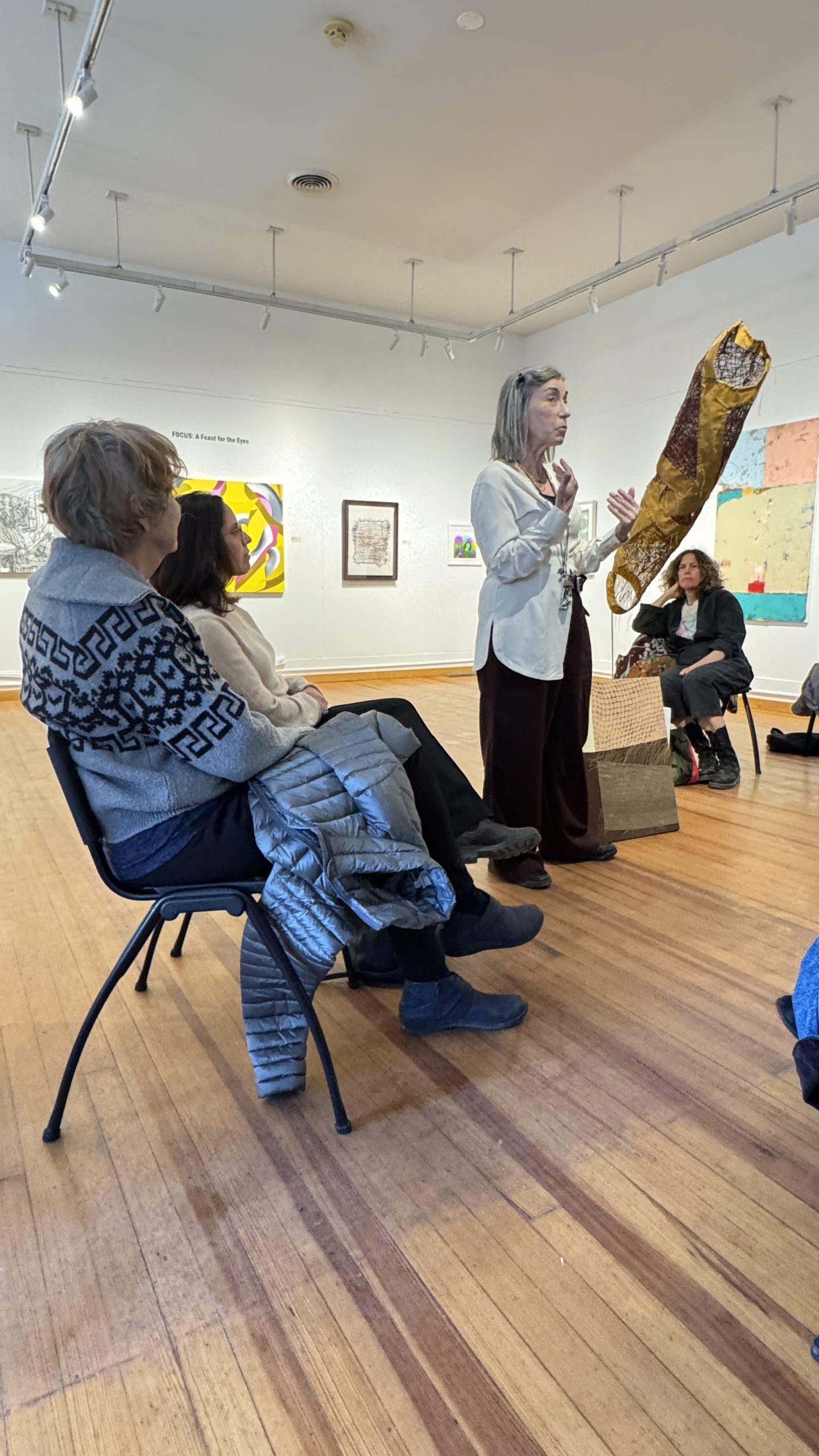
This past Saturday during the Focus exhibition art talk one artist spoke candidly about the
importance of process in sustaining an artistic life. Reflecting on the repetitive nature of stitching
and assembling materials, she remarked that artists must genuinely enjoy the act of making,
regardless of recognition or sales. That perspective resonated strongly within the gallery, where
many works reveal countless hours of careful labor. One could sense the patience embedded in
every seam, brushstroke, and layered surface. The exhibition invites viewers to appreciate not
only the finished pieces but also the dedication required to bring them into being.
Color plays a central role throughout the show, functioning almost as a character in its
own right. Some works employ saturated hues that seem to glow against neutral backgrounds,
while others rely on subtle shifts in tone to create depth and movement. In several pieces,
patterns repeat and overlap, producing optical effects that encourage the eye to wander. These
visual strategies create moments of surprise and discovery, prompting viewers to linger longer
than they might expect.
The lively atmosphere of the accompanying art talk reinforced the sense of shared
curiosity that defines the exhibition. Artists and visitors exchanged questions about technique,
inspiration, and the challenges of sustaining creative practice. Laughter occasionally punctuated
the discussion, but the prevailing tone remained one of attentive listening and thoughtful
reflection. The conversation demonstrated how art can serve as a catalyst for dialogue, bringing
people together to consider both aesthetic and personal experiences.
Beyond the main gallery, the exhibition Woodcuts ; Wood Engravings: A Survey from
the Permanent Collection curated by Goldberg, located in the Towbin Wing, offers a compelling
historical counterpoint. Drawing from a collection of more than two thousand works, the display
traces the evolution of printmaking in the Woodstock area from the early twentieth century to the
present. The exhibition highlights the role of woodcut and engraving techniques during periods
such as the Great Depression, when prints provided an accessible and widely distributed form of
artistic expression. By presenting works created across several decades reaching back as far as
the the 1920’s, the museum underscores the enduring significance of printmaking within the
region’s artistic heritage.
The third exhibition, Adrian Lee: Mimetic Modes, shifts the focus to contemporary social
issues through the medium of mixed media photography and collage. Lee’s work addresses
subjects such as economic inequality, religion, and environmental responsibility, often drawing
inspiration from personal experience and current events. During a gallery discussion, the artist
reflected on the moment when exposure to political activism reshaped his artistic direction,
explaining that hearing ideas that directly affected his life encouraged him to pursue more
socially engaged themes. His pieces combine layered imagery with symbolic elements, inviting
viewers to consider the relationship between visual culture and public discourse.
Together, the three exhibitions form a cohesive exploration of artistic expression across
time and medium. Focus: A Feast for the Eyes celebrates the sensory pleasures of color and
pattern, the woodcut survey honors the historical foundations of regional art, and Lee’s
exhibition challenges audiences to reflect on the complexities of contemporary society. The
balance among these themes reflects the broader mission of the Woodstock Artists Association
and Museum to support creativity in all its forms.
As the winter season drew to a close making way for spring, the museum’s current
offerings provide a timely reminder of the vitality of the arts within the Hudson Valley and
Catskills region. Visitors leave with a renewed appreciation for the diversity of artistic voices
working today, as well as the traditions that continue to shape their work. The exhibitions
demonstrate that art remains a powerful means of connection, capable of inspiring curiosity,
conversation, and community.

Mari Keeler Cornwell “Afstou”

WAAM Feast for the Eyes
WAAM Feast for the Eyes

Maxine Davidowitz “Land Totem II”
Maxine Davidowitz “Land Totem II”

Mari Keeler Corwall ‘Zulia’
Mari Keeler Corwall ‘Zulia’

Gimme Gardiner “Interspace Fifty-one”
Gimme Gardiner “Interspace Fifty-one”

Ellen Jouret-Epstein “PinkRibbonGallery”

WAAM Feast for the Eyes
WAAM Feast for the Eyes
WAAM Feast for the Eyes
WAAM Feast for the Eyes

WAAM Feast for the Eyes
WAAM Feast for the Eyes
